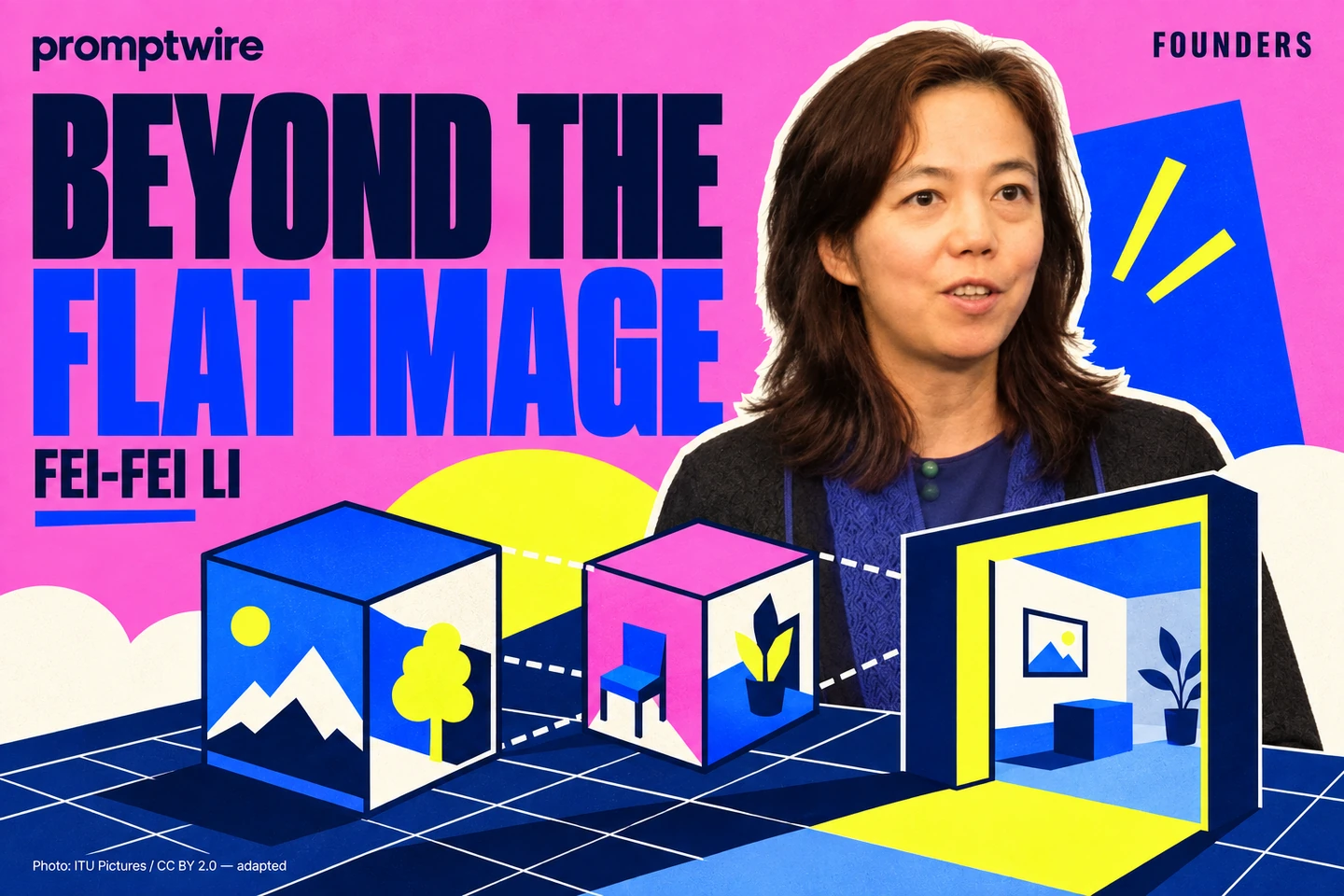
Fei-Fei Li is a co-founder of World Labs, an AI company focused on spatial intelligence. Its founding team also includes Justin Johnson, Ben Mildenhall and Christoph Lassner. Spatial intelligence concerns relationships between objects, places and actions in three-dimensional environments, extending the AI conversation beyond text and flat images.
- Person
- Fei-Fei Li
- Company
- World Labs
- Area of work
- Spatial intelligence and world models
A company built around space
World Labs names Fei-Fei Li, Justin Johnson, Ben Mildenhall and Christoph Lassner as its founders. The company describes its focus as spatial and physical intelligence: models that can perceive, generate, reason about and interact with worlds. Its team combines research, engineering, graphics and product work.
Public record: World Labs: About the company
What does spatial intelligence mean?
An image captures one view. A spatial representation must account for how an environment relates across viewpoints and, in some tasks, through time. Imagine walking around a chair: its geometry should not change because the camera moves. A system that generates an attractive front view has not necessarily learned a coherent scene. This is why spatial consistency, object relationships and controllable movement are useful questions when assessing world-model demonstrations.
What World Labs says about its direction
The company's about page describes models that perceive, generate, reason about and interact with virtual and physical worlds. It presents Marble as a product for creating persistent 3D environments from several kinds of input. These are the company's descriptions of its scope and products. They should not be read as independent evidence that a generated world behaves like the physical world in every respect or that a robotics system is ready for unrestricted deployment.
Why this matters to creators and builders
For a creator, a coherent environment could make it easier to explore camera positions without rebuilding an entire scene. For a developer, a persistent representation could support a different class of interface from a single generated image. These are applications to investigate, not guaranteed outcomes. Our analysis is that the important shift is from evaluating one attractive frame to evaluating an environment that remains useful as the user changes perspective.
A practical way to judge a spatial demo
Choose a small scene with visible object relationships, such as a table, two chairs and a doorway. Move the viewpoint and check whether relative positions, scale and occlusions remain coherent. Ask what can be edited, exported or measured, and which properties are generated approximations. For a physical-world application, a separate safety and validation process is necessary. An impressive virtual scene does not establish dependable physical interaction.
Questions about Fei-Fei Li
Who founded World Labs?
World Labs names Fei-Fei Li, Justin Johnson, Ben Mildenhall and Christoph Lassner as its founders. It describes a team combining machine learning, computer vision, graphics and product disciplines.
Is a world model the same as an image generator?
No. A world-model application aims to represent relationships across an environment. A single generated image may look convincing without preserving those relationships when the viewpoint changes.
Follow the evidence.
This AI-assisted profile combines the linked public record with Promptwire's editorial analysis. It is not an interview or a hands-on product review. Suggested tests are proposals, not reported results. Dated roles describe the period identified in the text. Company claims are attributed to their source.
Public sources support the factual background. Analysis and illustrative exercises are identified in the text. How we assess AI · Editorial standards
Spot a factual error or an outdated detail?