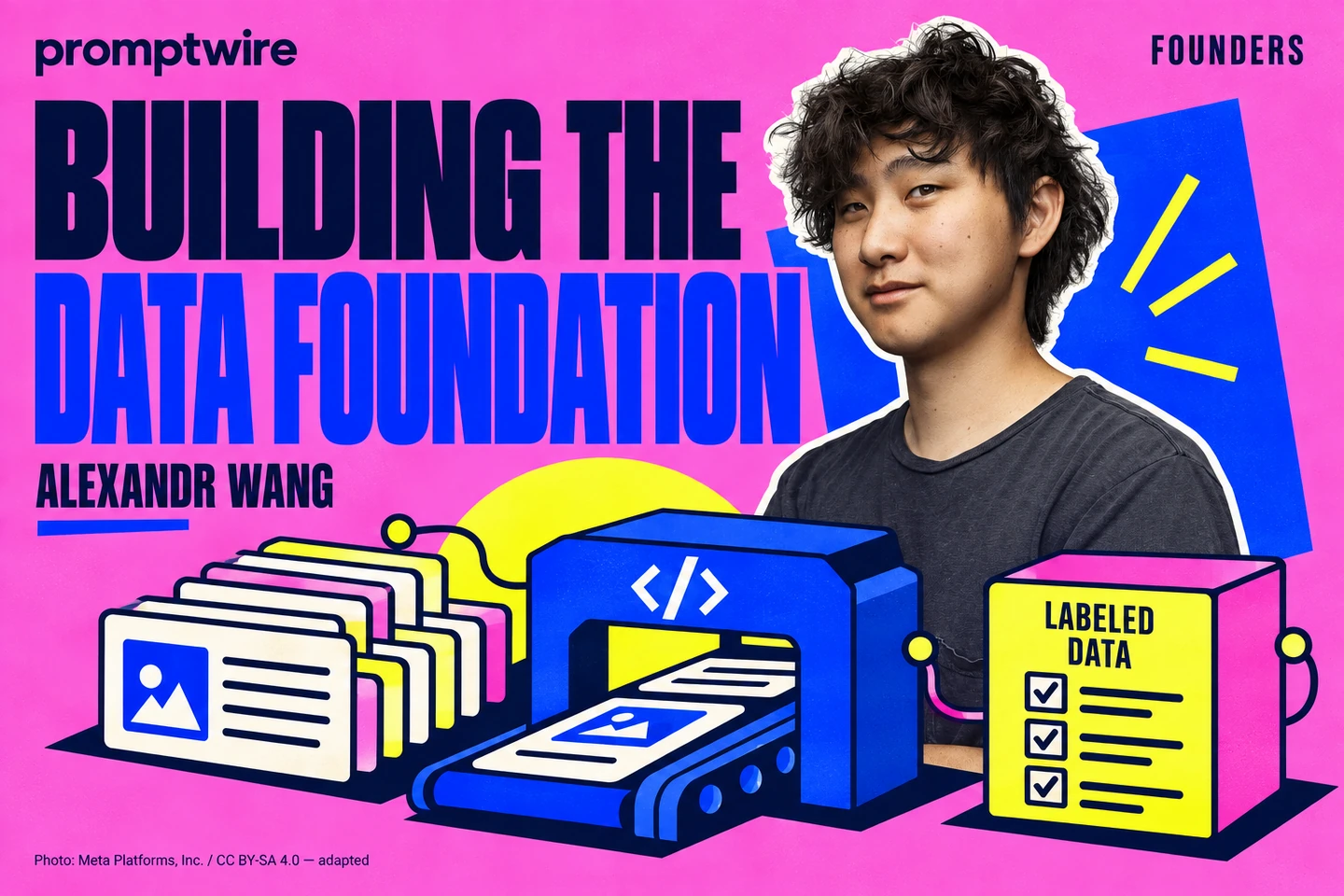
Alexandr Wang co-founded Scale AI with Lucy Guo. Y Combinator's early founder interview describes an API connecting software with tasks requiring human judgement. This profile examines that founding chapter and its relevance to training data and evaluation, rather than assigning Wang a current role from a historical source.
- Person
- Alexandr Wang
- Company chapter
- Scale AI
- Area of work
- Data quality and human judgement
An infrastructure starting point
In Y Combinator’s early interview with Scale, co-founders Alexandr Wang and Lucy Guo described an API for work that required human judgement, including categorisation and information extraction. This profile focuses on that founding chapter, rather than implying Wang holds the same operational role today.
Public record: Scale AI: founder biography or company record
Why labelled data is more than a collection of answers
A label reflects a definition. If two reviewers interpret a category differently, the resulting dataset can encode an unresolved policy choice rather than a clear target. A system trained or evaluated on those labels inherits that ambiguity. Scale's early product description connected human work with a software interface, making the organisation of judgement part of the technical story. Readers should ask how instructions, review and disagreement are handled, not simply how many examples a dataset contains.
What a data-quality problem looks like
Imagine labelling customer messages as complaints or requests. A message saying that a promised refund has not arrived may reasonably fit both categories. Forcing it into one class without a rule creates inconsistent supervision. Our analysis is that the important work begins with defining the intended downstream action: does the business need sentiment, urgency or routing? Clear task design can matter more than adding more examples to an ambiguous dataset. This illustrative scenario is not a description of a Scale customer or a reported result.
How buyers should assess an annotation workflow
Prepare a small set containing straightforward examples, borderline cases and intentionally incomplete information. Compare reviewer agreement and inspect the reasons for disagreement. Check how changes to the guidelines are versioned and whether old labels need revision. Include a quality review process that can detect systematic errors, not only random mistakes. The aim is to establish whether the dataset represents the decision you actually want the AI system to learn or measure. Founder reputation and production volume cannot answer that question on their own.
Questions about Alexandr Wang
Who founded Scale AI with Alexandr Wang?
Y Combinator's early interview names Lucy Guo alongside Wang as a co-founder.
Does more labelled data always improve an AI system?
No. More examples can repeat inconsistent definitions or systematic errors. Relevance, quality and the fit between labels and the intended task matter.
Follow the evidence.
This AI-assisted profile combines the linked public record with Promptwire's editorial analysis. It is not an interview or a hands-on product review. Suggested tests are proposals, not reported results. Dated roles describe the period identified in the text. Company claims are attributed to their source.
Public sources support the factual background. Analysis and illustrative exercises are identified in the text. How we assess AI · Editorial standards
Spot a factual error or an outdated detail?