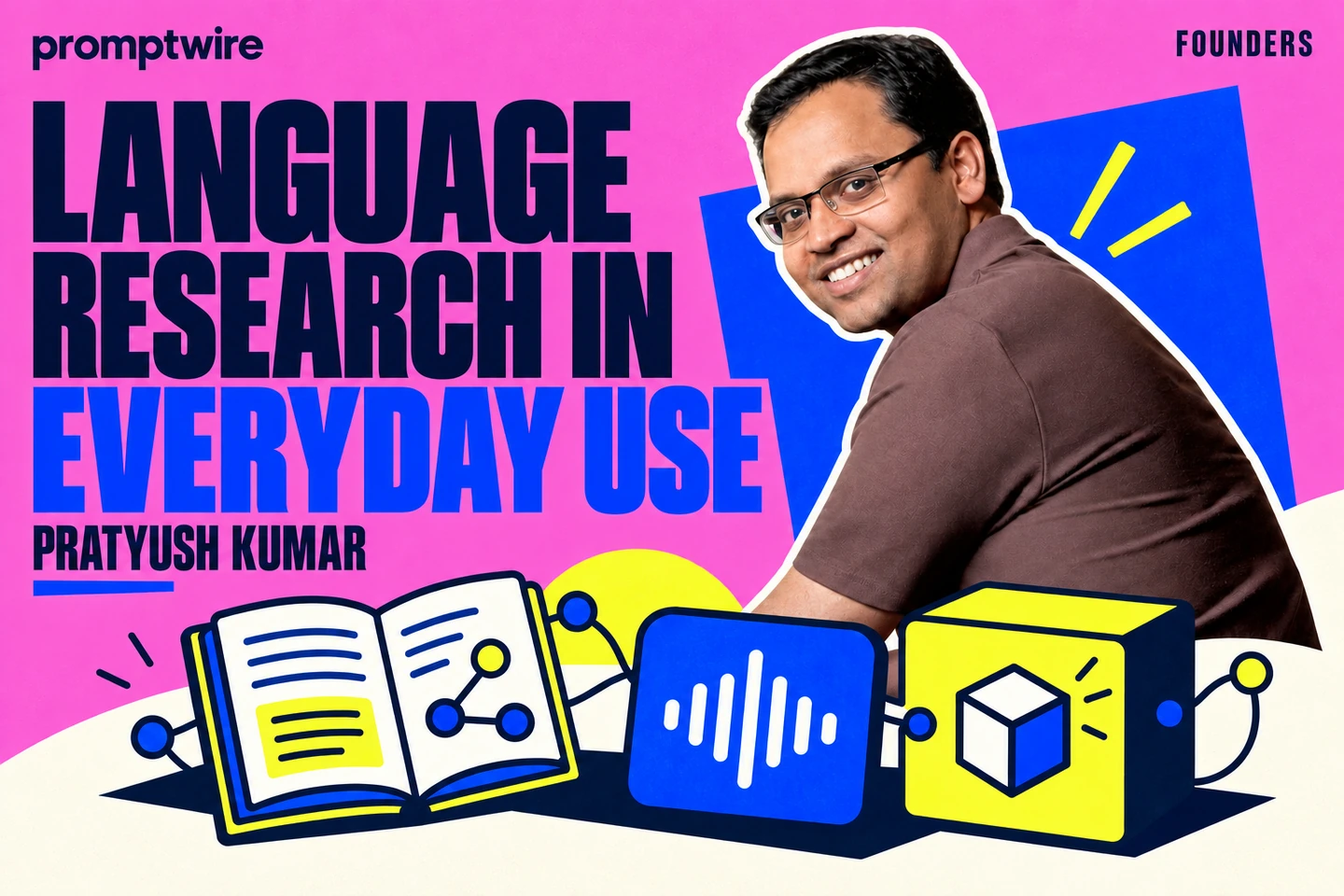
Pratyush Kumar co-founded Sarvam AI with Vivek Raghavan. The company's launch announcement connected its direction with AI for India and Indian-language use. His profile examines how language research becomes a product decision, particularly when a user speaks naturally rather than matching the clean examples in a demonstration.
- Person
- Pratyush Kumar
- Company
- Sarvam AI
- Area of work
- Multilingual research and everyday language use
A company built around a context
Sarvam’s launch announcement introduced Pratyush Kumar and Vivek Raghavan as co-founders and set out an ambition to build AI for India. That is a broad company thesis. Its practical meaning depends on which users, languages and workflows receive attention in each release.
Public record: Sarvam AI: founder biography or company record
Why code-switching deserves its own evaluation
People often combine a regional language with English product names, workplace terms or numbers. This is not necessarily an error to be corrected; it can be the natural form of the request. An AI system may recognise both languages individually yet mishandle the switch between them. Our analysis is that India-focused evaluations should include authentic mixed-language examples alongside formally translated prompts. A clean translation benchmark and an everyday conversation test answer related but different questions.
How to distinguish language fluency from task accuracy
A response can sound natural while changing an amount, omitting a condition or misidentifying a person. For practical use, reviewers should score preserved facts and completed intent separately from grammar or style. Sarvam's founding thesis gives context for this problem, but no company-wide claim can replace testing a particular model and task. The same principle applies to voice: a pleasant delivery should not hide recognition errors in names, dates or other details the user cannot afford to lose.
Building a small local-language test set
Choose a workflow such as booking an appointment or summarising a support request. Ask fluent speakers to write natural examples rather than translating every English sentence literally. Include regional names, colloquial phrasing and cases with missing information. Keep the expected facts explicit and record reviewer disagreements. This is an illustrative evaluation method, not a reported Sarvam study. It produces evidence that can guide a deployment decision while avoiding the assumption that one language score represents all dialects, domains and ways of speaking.
Questions about Pratyush Kumar
Is code-switching just bad translation?
No. It is the use of more than one language within a conversation or utterance. It can be a normal communication pattern that a useful system should handle appropriately.
How should Indian-language AI quality be measured?
Use task-specific examples reviewed by competent speakers, and separate meaning, factual accuracy and usability from surface fluency. Record the exact release and conditions tested.
Follow the evidence.
This AI-assisted profile combines the linked public record with Promptwire's editorial analysis. It is not an interview or a hands-on product review. Suggested tests are proposals, not reported results. Dated roles describe the period identified in the text. Company claims are attributed to their source.
Public sources support the factual background. Analysis and illustrative exercises are identified in the text. How we assess AI · Editorial standards
Spot a factual error or an outdated detail?