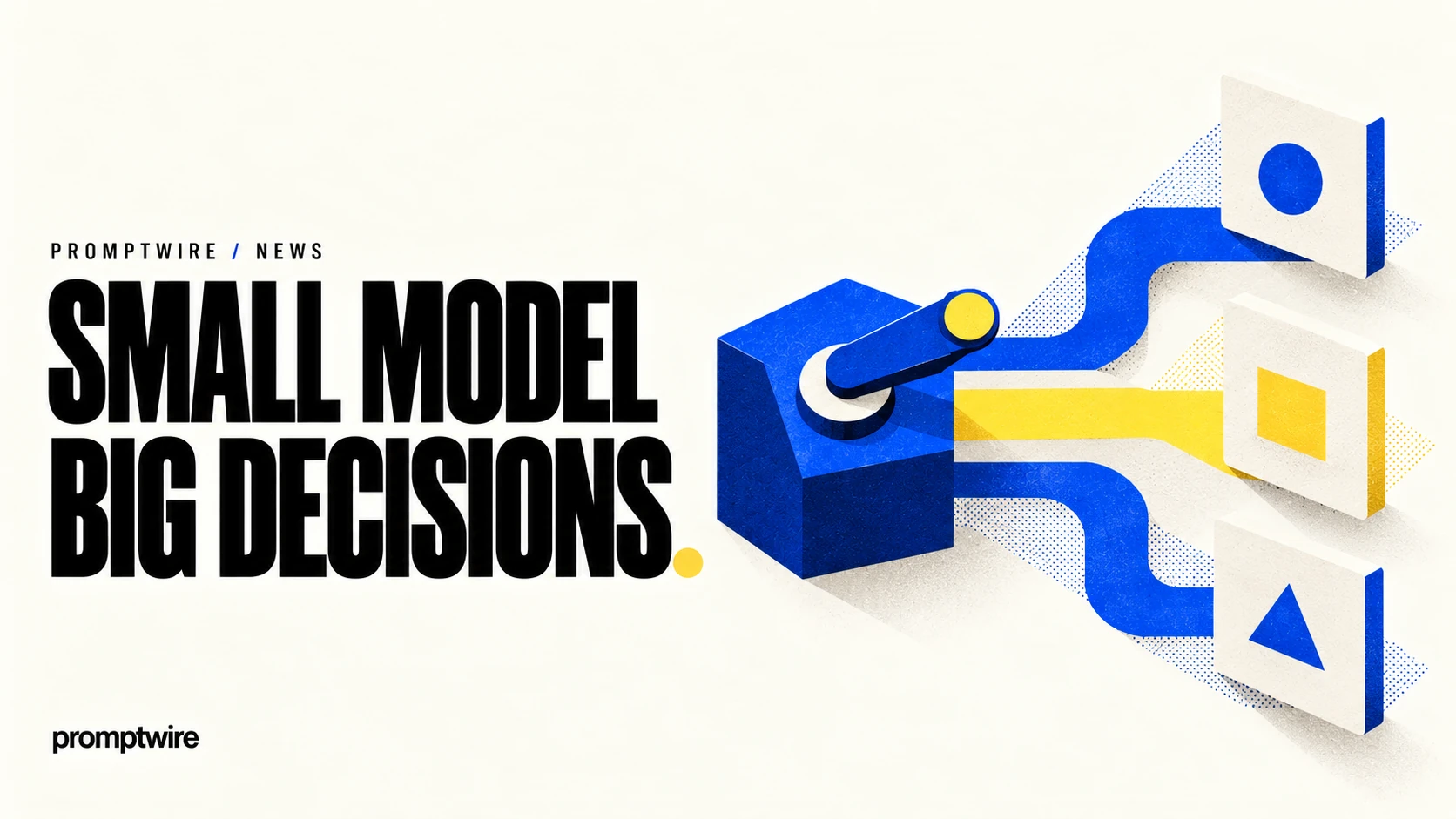
Microsoft announced Microsoft-Decision-1 on October 9, 2026, with access through Microsoft Foundry and OpenRouter. It returns scores for predefined choices. For businesses, the interesting opportunity is using a focused model to sort incoming work or check an agent’s next step before the application acts.
Read the dated primary source ↓What Microsoft released
Microsoft built Decision-1 by post-training Alibaba’s Qwen3.5-9B. The announcement targets classification, routing and workflow control. Microsoft reports leading accuracy in its own 36-benchmark comparison and faster responses than the alternatives it tested. These are vendor results; Promptwire has not independently reproduced them.
The practical question is whether that performance carries over to your queue, categories and messy customer messages. A launch benchmark gives you a candidate to evaluate, rather than a finished business case.
Public record: Microsoft — Decision-1 announcement, October 9, 2026
How a decision model fits into a workflow
The Foundry documentation describes three question formats: a yes/no probability, selection among fixed choices, and a score on an ordered scale. The application supplies the situation and criteria; the response is numerical and structured, without a written rationale.
For an illustrative support workflow, define billing, technical and account-access categories. A message about a duplicate charge can be scored against those options. The application then routes the ticket; a separate reply-writing step can follow. This is an example of how to design a pilot, not a result from our testing.
Public record: Microsoft Learn — Deploy and use Microsoft-Decision-1
Price: $0.042 per million input tokens
Microsoft lists input tokens at $0.042 per million, with output tokens free. That is API usage pricing, not a subscription fee.
Illustrative arithmetic: 10,000 requests using 1,000 input tokens each would consume 10 million input tokens, costing $0.42 at that rate. This excludes other charges, retries and operational costs. The actual bill depends on measured usage.
The routing decision may be inexpensive while integration and exception handling remain substantial. Compare the cost per correctly handled ticket, including human corrections, before deciding whether the pilot is worthwhile.
Public record: Microsoft — Decision-1 announcement, October 9, 2026
What it can and cannot do
The Foundry model card lists text input, JSON output and a 32,768-token context window. It supports evidence checks and an explicit “cannot tell” option. It does not write summaries, translate, hold conversations or process images, audio or video.
Microsoft also excludes using it as the sole automated decision-maker for consequential decisions about people, including employment, credit and healthcare. The integrating application must define choices, thresholds, escalation and oversight. A probability score alone does not establish permission to perform an action.
Public record: Microsoft Foundry — Decision-1 model card
Three practical starting points
These are Promptwire’s proposed pilots. Start with archived examples that a person has already reviewed, and keep the pilot separate from live actions.
| Workflow | Proposed decision | Measure |
|---|---|---|
| Support inbox | Pick the team that should receive a ticket. | Correct routing, ambiguous cases and correction time. |
| Customer feedback | Assign one of your existing product themes. | Agreement with reviewed labels and missed themes. |
| Agent review | Flag proposed steps for additional review. | Missed risky actions and unnecessary escalations. |
Editorial suggestions, not tested performance claims.
How to evaluate it before adoption
Microsoft’s setup guide uses a dedicated decision endpoint. Plan for an integration change rather than assuming an existing chat request will work. Its documentation recommends validating thresholds on labeled examples and measuring latency for your deployment.
Our advice: assemble a representative set with clear cases, overlapping categories and missing information. Record each expected decision before running the model. Compare errors by category, the proportion needing review, response time and total spend. Retest after changing the category descriptions.
Keep application permission rules independent of the score. If the model identifies a proposed action as acceptable, the application should still check whether that action is allowed for the current user and situation.
Public record: Microsoft Learn — Deploy and use Microsoft-Decision-1
The Promptwire take
Decision-1 is a useful signal for product builders: separate the short choice from the longer piece of work. A support system may need one component to decide where a message goes and another to prepare the response.
Begin with a recurring queue where mistakes are visible and reversible. Expand only when your own results demonstrate acceptable quality and manageable review effort. The meaningful saving is in completed work, after exceptions and corrections.
Questions readers ask
Is Microsoft-Decision-1 a chatbot?
No. It scores bounded choices and returns structured decisions; it does not generate conversational replies.
Where can developers access it?
Microsoft’s announcement links to Microsoft Foundry and OpenRouter. Follow the chosen provider’s setup and decision API documentation.
Can it explain its answer?
The model card says it does not produce rationales. Keep the supplied evidence and decision criteria available for review.
Follow the evidence.
AI-assisted news analysis. Primary sources checked on October 12, 2026. The release is dated October 9. Benchmark claims are attributed to Microsoft and have not been independently reproduced by Promptwire. Cost arithmetic and pilot recommendations are illustrative editorial analysis.
- Microsoft — Decision-1 announcement, October 9, 2026
- Microsoft Learn — Deploy and use Microsoft-Decision-1
- Microsoft Foundry — Decision-1 model card
Public sources support the factual background. Analysis and illustrative exercises are identified in the text. How we assess AI · Editorial standards
Spot a factual error or an outdated detail?