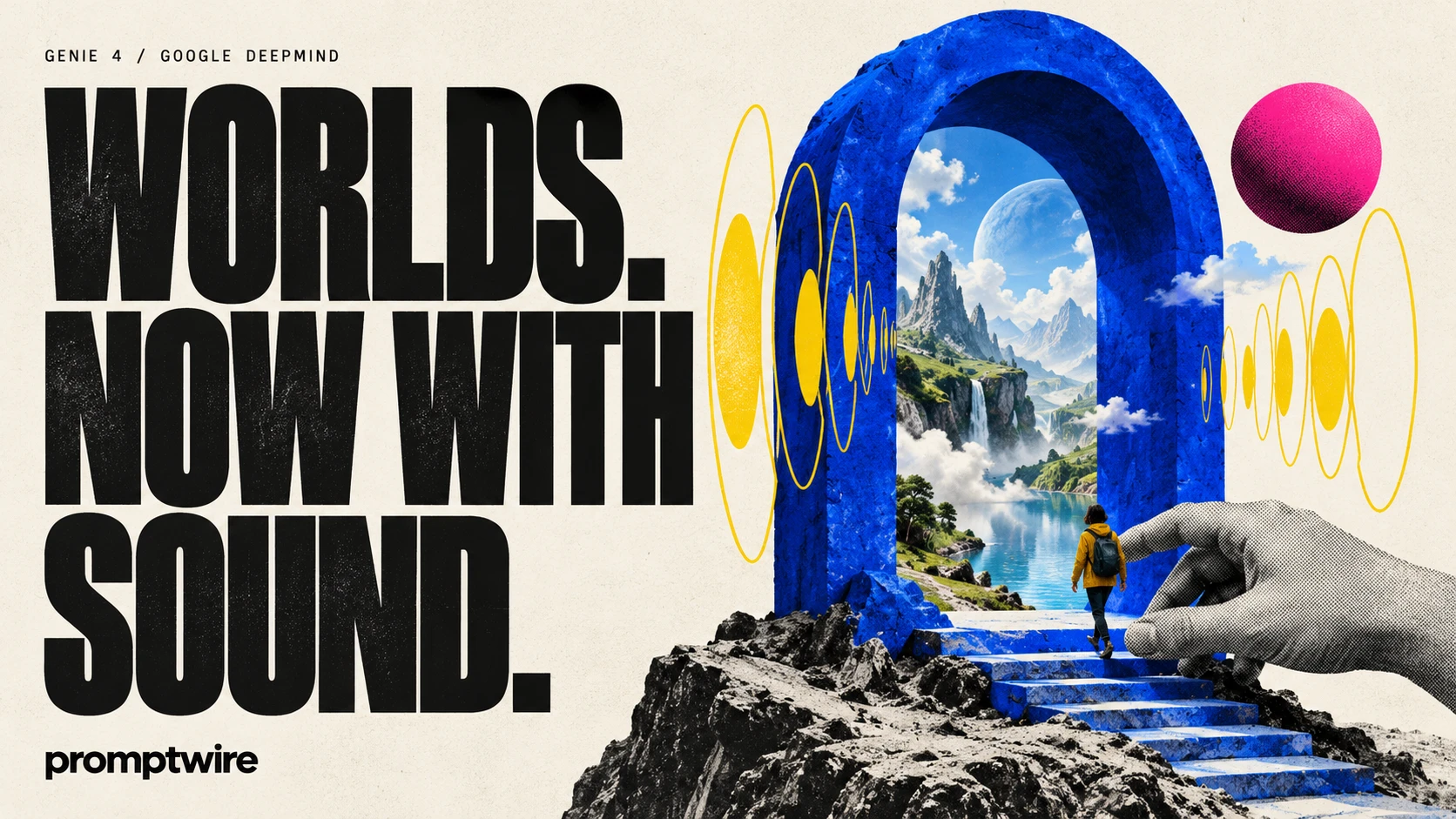
A scene becomes a different creative medium when you can interrupt it. Genie 4 invites that interruption: change something while the world is unfolding and hear the response. The interesting question is whether the scene retains the details that made the experiment worth running.
Read the dated primary source ↓Watch: Google’s interactive AI worlds
Watch Promptwire’s video on Google’s interactive AI worlds, then explore Genie 4’s capabilities and limitations below. Watch on YouTube.
What Google announced on October 27
Google DeepMind announced Genie 4 on October 27, 2026, as a research preview of its interactive world model. The company says it generates audio alongside the world, including music, environmental sound and dialogue.
DeepMind describes a system drawing on the Gemini family: Gemini Omni contributes real-world appearance and behavior, with other Gemini models supporting coherence and continuity. These are the developer’s descriptions; Promptwire has not independently tested the preview.
Public record: Google DeepMind — Genie 4 announcement, October 27, 2026
Live steering changes the creative task
Google’s companion announcement describes natural-language control while a scene runs: moving a camera, changing weather or introducing characters. Sound is generated on the fly. Google points to potential uses across creative industries and training environments for robots and agents.
For a filmmaker, the appeal would be asking a spatial question rather than requesting another isolated clip. What happens to the mood if rain starts during a walk? Does a conversation still read clearly when the camera moves behind a character? An interactive draft could help a team decide which version deserves a more deliberate production.
That is an editorial interpretation of the format, not a claim that Genie 4 already fits an established film pipeline. A compelling exploratory scene and an editable, repeatable production asset solve different problems.
Public record: Google — real-time steering and preview availability
Who can use it now?
As checked October 28, Google says access has started with a limited group of trusted testers. Google AI Ultra subscribers in Project Genie and early access partners using the Gemini API and Google AI Studio are listed as coming soon. DeepMind’s announcement links a waitlist.
Keep that distinction in a project brief. A preview announcement gives a team something to investigate; it does not supply an immediately available production dependency. Teams planning a deadline should confirm their own access before promising a deliverable built around the model.
Public record: Google — real-time steering and preview availability · Google DeepMind — Genie 4 announcement, October 27, 2026
A believable world can still lose track of itself
DeepMind’s model page lists drifting visual details and object permanence, imperfect real-world locations, difficult interactions among multiple agents and ongoing audio-accuracy work. It says continuous interaction lasts a few minutes rather than extended sessions. Generated video and audio include SynthID watermarking, according to the company.
These limits matter whenever a scene is used to make an inference. If an object changes after the camera turns away, a viewer could mistake a continuity error for an effect of their intervention. A realistic-looking response alone cannot validate a physical prediction.
For robotics research, the useful evidence would concern which behaviors transfer to a real environment and under what conditions. An attractive demonstration cannot answer that by itself. For creative exploration, a surprising response might instead be exactly the point.
Public record: Google DeepMind — Genie 4 capabilities, limitations and responsibility
A first viewing should follow one detail
When access becomes available, try a small scene with one distinctive object: a red cup on a table beside a doorway. Establish its position, move the camera through the door, change the weather, then return. Ask whether the cup, table and doorway retain their relationship. Listen for whether outdoor rain and indoor sound remain appropriate as the viewpoint changes.
Keep a record of the prompt edits and the moment each visible or audible change occurs. Repeat the sequence to see which outcomes persist. This is a proposed observation exercise, not a benchmark or a report of testing Genie 4.
The exercise separates two reasons to care about world models. One is their capacity to produce an unexpected idea worth developing. The other is their ability to preserve a situation well enough to reason about it. Genie 4’s preview makes the first possibility vivid; evidence for the second requires watching what survives the interaction.
Questions readers ask
Was Genie 4 announced or broadly released?
Google announced it on October 27, 2026, with a limited trusted-tester preview. Broader consumer and developer access is described as coming soon.
Does Genie 4 generate sound?
Google says it generates native audio, including environmental sound, music and dialogue, alongside its interactive worlds.
Follow the evidence.
AI-assisted news analysis. Primary sources checked October 28, 2026. Capabilities and availability are attributed to Google; Promptwire has not independently tested Genie 4. Workflow implications and the observation exercise are original editorial analysis. Cover is an AI-generated conceptual illustration, not a product screenshot.
- Google DeepMind — Genie 4 announcement, October 27, 2026
- Google — real-time steering and preview availability
- Google DeepMind — Genie 4 capabilities, limitations and responsibility
Public sources support the factual background. Analysis and illustrative exercises are identified in the text. How we assess AI · Editorial standards
Spot a factual error or an outdated detail?