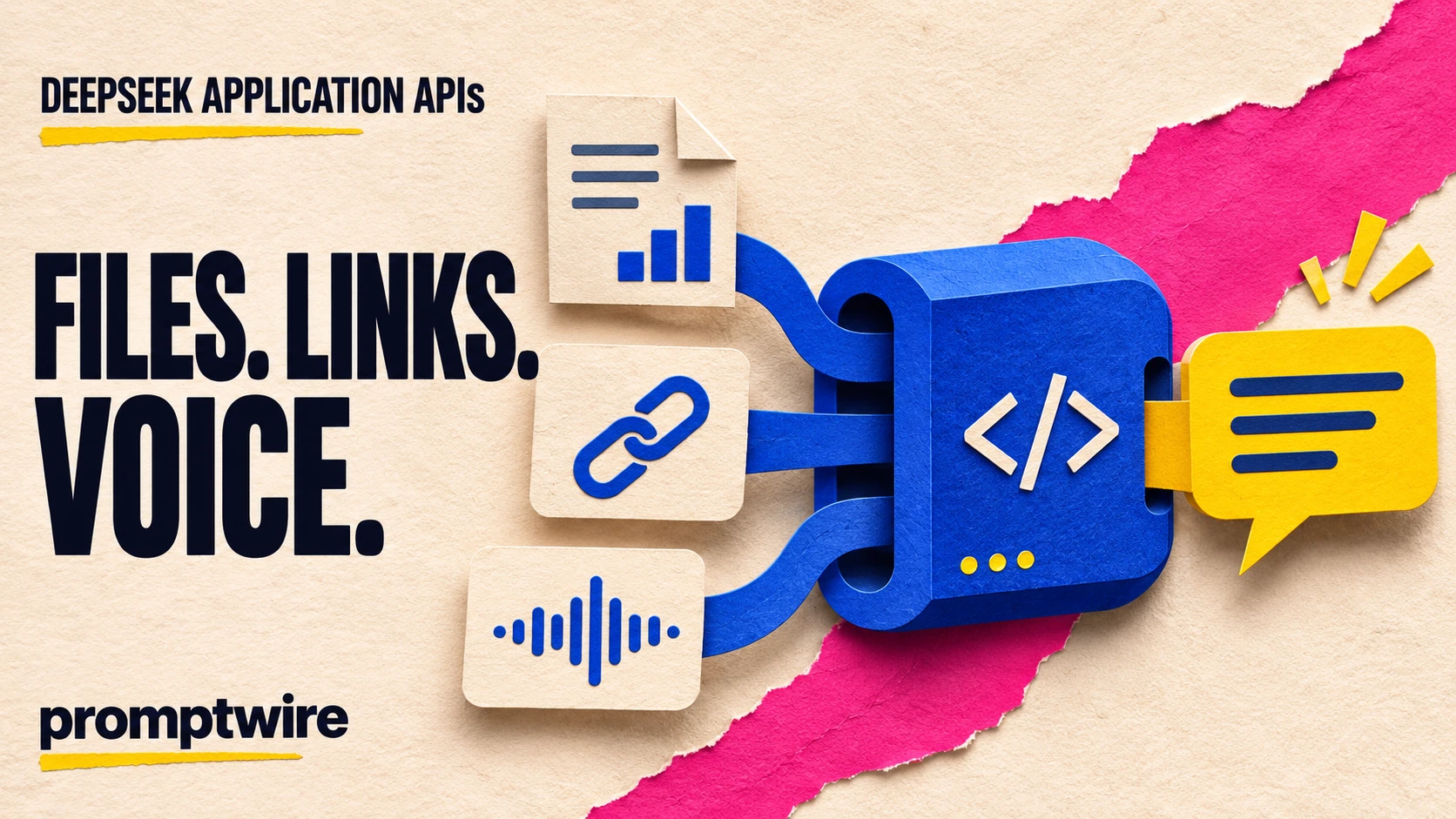
DeepSeek has opened a broader set of application APIs for building custom chatbots around deepseek-flash. The release combines managed web tools with file input, voice services and content checks; the details matter as much as the feature list.
Read the dated primary source ↓What changed on November 13
DeepSeek’s November 13, 2026 changelog announces its full suite of application APIs. Developers can enable conversation features in the Messages, Responses and Chat Completions interfaces using deepseek-flash. DeepSeek handles the tool calls and assembly of retrieved material into the conversation context.
The release also makes underlying capabilities available separately, including OCR, speech recognition and text-to-speech. It is an expansion of the application-building toolkit. The standalone Search and Fetch APIs were already announced on October 17; this is not their first release.
Public record: DeepSeek changelog — November 13, 2026 release
Files need the right parsing choice
The file guide describes a two-step flow: upload and parse a document, then reference its file_id in a chat request. The text_recognition option keeps text but drops figures. The rich_layout_recognition option includes detected charts, photos and diagrams at their positions in the text.
That distinction matters for a report whose conclusion depends on a chart. Rich-layout parsing still does not guarantee that every figure is detected. DeepSeek also warns that cropped figures consume image input tokens.
A request can reference up to 20 documents, with their text totalling no more than 8 MiB. Repeating a file reference counts again. The guide says parsed content remains in context across turns and an oversized context returns an error rather than silently trimming documents.
Public record: DeepSeek — File Parsing guide
Managed tools change what the client must handle
The web-tools guide distinguishes model-managed retrieval from calling Search and Fetch in your own code. With managed tools, the model decides when to search or read a link and the service executes the action. Search can operate with or without thinking enabled; thinking mode supports a sequence of retrieval steps.
URL reading considers at most the first ten distinct URLs in the latest user message, and the model chooses which to read. Reading several links reduces the space available to each page, so long pages can be truncated.
The chatbot guide says the client must display the returned content blocks and preserve them unchanged for the next round. It also documents ignored request controls when these features are enabled. For example, max_output_tokens in the Responses API limits each inference step, not the entire round. A familiar API shape therefore does not imply identical behaviour for every parameter.
Public record: DeepSeek — Web Tools guide · DeepSeek — Build a Chatbot guide
The toolkit has several billing units
The pricing page separates model tokens from retrieval, document processing and speech. As checked on November 14, it lists the following rates in US dollars.
| Capability | Listed rate |
|---|---|
| Search or web fetch | $0.75 per 1,000 uses for each service |
| File parsing or OCR | $0.225 per 1,000 pages |
| Text-to-speech | $0.45 per 10,000 characters; limited-time rate $0.225 |
| Speech recognition | $0.116 per audio hour; limited-time rate $0.058 |
Model input and output tokens are additional. The speech discounts are labelled limited-time; this article does not assume an end date.
Public record: DeepSeek — Models & Pricing, checked November 14, 2026
A streamed answer can still end in a refusal
DeepSeek’s content-safety guide says high-level checking reviews both input and output. Review continues after the model finishes generating, so a client must inspect the final outcome. If a streamed response ends in a refusal, the guide instructs the client to remove the displayed answer and show its refusal message.
The review’s tokens are billed as output tokens. DeepSeek describes this as basic risk control and says it does not replace the service provider’s own content-review responsibilities.
Public record: DeepSeek — Model Content Safety guide
Promptwire’s take: test the missing information
Our suggested first trial is a small assistant that answers questions from a public PDF and a product-information page. Include one question that requires reading a chart, one whose answer appears only near the end of the page, and one the supplied material cannot answer.
Inspect the retrieved evidence alongside the final reply. Record missed figures, truncated passages, unsupported conclusions and the full charge for the conversation. A clean interface can conceal an incomplete source, so the evaluation should include what the assistant failed to read.
For builders, the appeal is less retrieval plumbing to assemble. The remaining work is still substantial: make sources inspectable, preserve conversation state correctly and handle errors visibly. These are editorial recommendations, not findings from a Promptwire benchmark. We have not independently tested the new suite.
Questions readers ask
Is this a new DeepSeek model release?
The announcement opens application capabilities around the existing deepseek-flash identifier. Its focus is the toolkit for custom conversations, rather than a newly named model.
Does a file need to be parsed again for every question?
The file guide says parsing is billed at upload when it succeeds. Later chat requests pay for the document’s input tokens, without another parsing charge.
Follow the evidence.
Primary documentation checked November 14, 2026. Features, limits and prices are attributed to DeepSeek. Promptwire has not independently tested the suite. Evaluation suggestions are editorial analysis. Cover: AI-assisted conceptual illustration, not a product screenshot.
- DeepSeek changelog — November 13, 2026 release
- DeepSeek — Build a Chatbot guide
- DeepSeek — File Parsing guide
- DeepSeek — Web Tools guide
- DeepSeek — Models & Pricing, checked November 14, 2026
- DeepSeek — Model Content Safety guide
Public sources support the factual background. Analysis and illustrative exercises are identified in the text. How we assess AI · Editorial standards
Spot a factual error or an outdated detail?