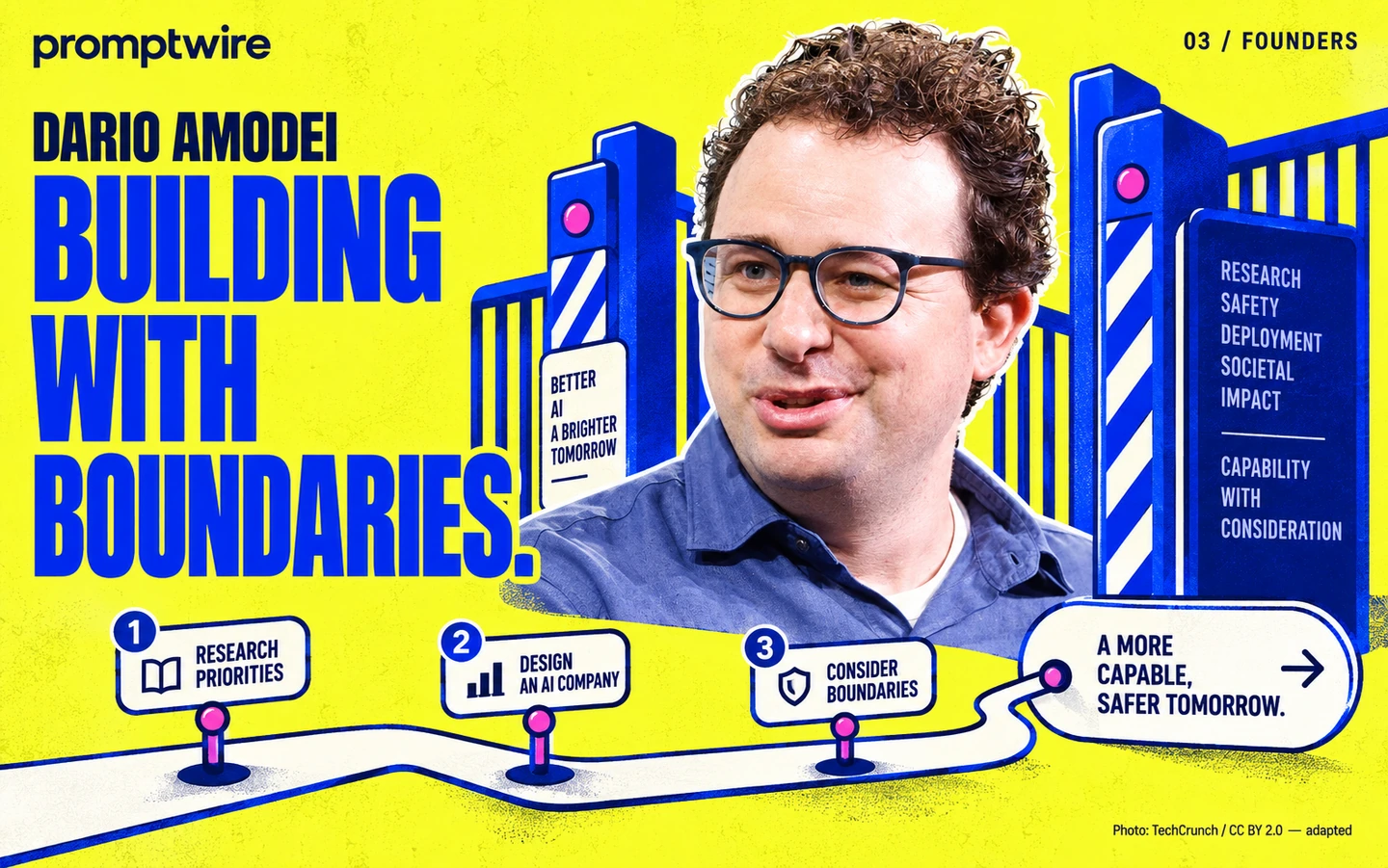
Dario Amodei is Anthropic's co-founder and chief executive. The company's leadership page assigns him responsibility for research direction and strategy. His profile connects the Claude product family with a wider question: how to develop capable AI systems whose behaviour can be investigated, evaluated and directed.
- Person
- Dario Amodei
- Company
- Anthropic
- Area of work
- Frontier models and AI safety
The research-led company
Anthropic identifies Dario Amodei as its co-founder and chief executive, responsible for research direction and strategic vision. Its leadership description emphasises systems that can be understood and directed more reliably. Claude is the company’s major assistant product, connecting that research programme with everyday and enterprise work.
Public record: Anthropic leadership
What is Anthropic trying to build?
Anthropic describes its research priorities in terms of reliability, interpretability and steerability. These ideas are related but different. Reliability concerns whether a system works consistently on a task. Interpretability concerns understanding its internal mechanisms. Steerability concerns whether instructions and controls can guide its behaviour. A strong result on one dimension does not establish the other two. Readers should look for the relevant evidence rather than treating the word safety as a single product feature.
Why a research priority becomes a product decision
A document assistant has to decide how to handle contradictory sources, missing evidence and instructions embedded inside uploaded files. Those are product behaviours as well as research questions. For an enterprise using Claude, the practical issue is not only whether an answer sounds useful. It is whether the workflow produces an inspectable result, operates within granted permissions and handles uncertainty clearly. Our analysis is that this connection between research and deployment is central to understanding Amodei's company-building story.
How to read claims about safer AI
Start with the scope of the evaluation. Was the test about harmful requests, factual reliability, tool use or a particular threat model? Which version was tested, and which safeguards were enabled? A reported improvement in one evaluation does not establish universal safety. Company-authored papers are valuable primary evidence of methods and stated priorities, but their conclusions should be separated from independent replication and from performance in your own task.
An evaluation example for a business reader
Give an assistant a small policy pack containing an outdated rule and a newer amendment. Ask a question that requires noticing the change, and another that the documents do not answer. A useful outcome cites the right document, explains the conflict and declines to fill the gap with an invented policy. This is an illustrative test design, not a claim that we ran Claude through it. It converts a broad promise about reliability into something a team can inspect.
Questions about Dario Amodei
What is Dario Amodei's role at Anthropic?
Anthropic's leadership page identifies him as co-founder and CEO, leading research direction and strategic vision. The same page distinguishes this from Daniela Amodei's organisational responsibilities.
Does interpretability mean a model never makes mistakes?
No. Understanding aspects of a model's internal behaviour is different from proving that every output is correct. Task evaluations and operational safeguards are still needed.
Follow the evidence.
This AI-assisted profile combines the linked public record with Promptwire's editorial analysis. It is not an interview or a hands-on product review. Suggested tests are proposals, not reported results. Dated roles describe the period identified in the text. Company claims are attributed to their source.
Public sources support the factual background. Analysis and illustrative exercises are identified in the text. How we assess AI · Editorial standards
Spot a factual error or an outdated detail?