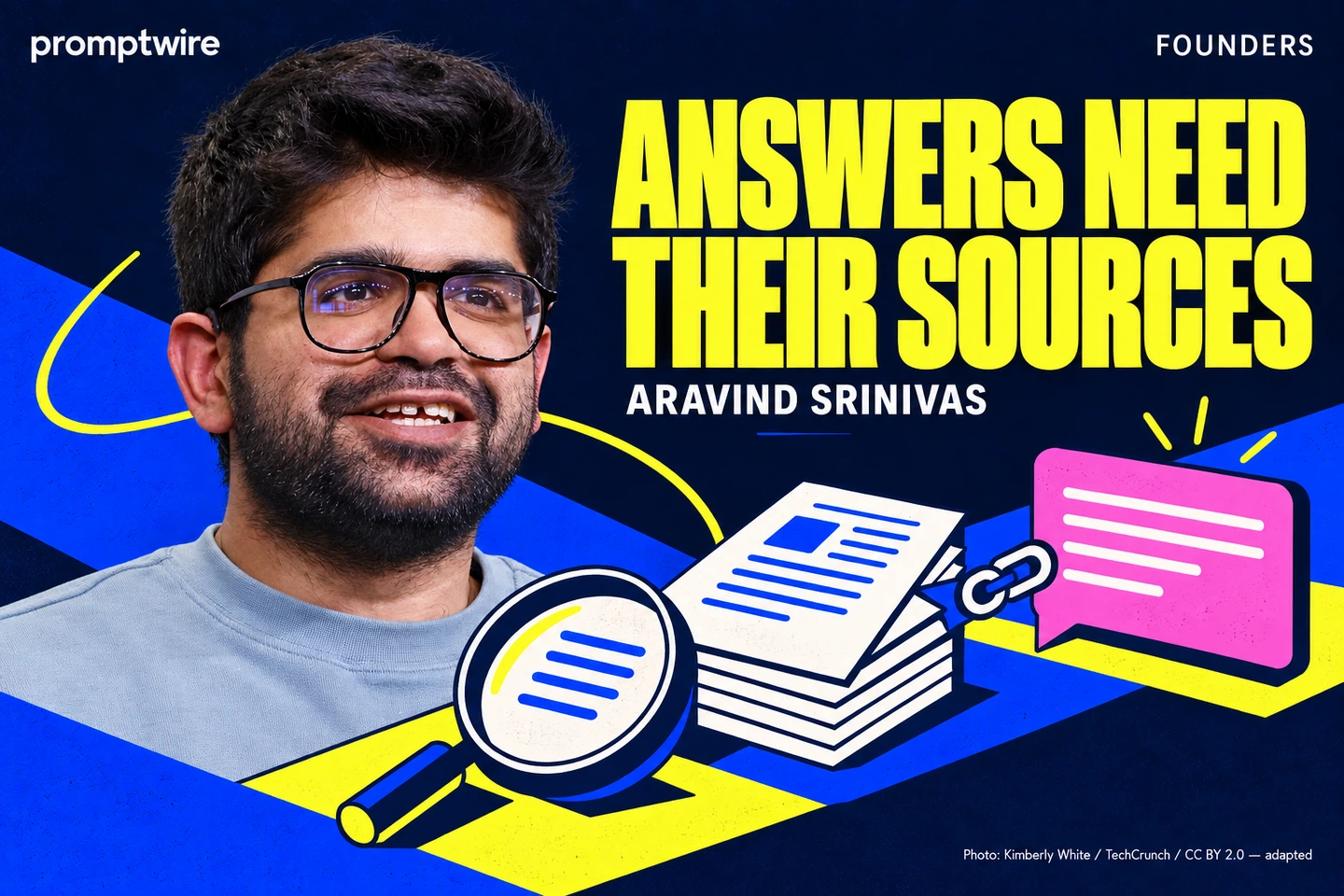
Aravind Srinivas is Perplexity's co-founder and chief executive, as identified in UC Berkeley's account of a founder conversation. Perplexity connects AI-generated answers with web sources. His profile offers a way to examine an important product shift: moving from discovering documents to receiving a synthesised answer that still needs evidence.
- Person
- Aravind Srinivas
- Company
- Perplexity
- Area of work
- AI search and source-based answers
Research experience meets a product
UC Berkeley’s account of a conversation with Aravind Srinivas identifies him as Perplexity’s co-founder and chief executive, and as a Berkeley PhD alumnus. The company’s search-and-answer experience gives readers a visible example of AI changing how information is discovered and synthesised.
Public record: UC Berkeley: A conversation with Aravind Srinivas
How is an answer engine different from a results page?
A results page gives readers a set of documents to inspect. An answer engine also selects information and writes a response. This can reduce the effort needed to begin learning about a topic, but it introduces a new evaluation problem: whether the generated answer accurately represents the material it cites. The presence of links is useful, yet a link beside a sentence does not guarantee that the source supports that sentence.
What retrieval contributes to an AI answer
Retrieval can supply current or specialised information that was not available in a model's training. The system still has to choose appropriate documents, extract the relevant parts and avoid overstating the findings. A failure can occur at any of those stages. For readers of Srinivas's story, this makes source selection and presentation as important as the underlying language model.
An example of careful AI-assisted research
Suppose you are comparing two vendors' data policies. Ask for the exact policy pages and effective dates, then open those pages before drafting a conclusion. A marketing description and a contractual commitment are different kinds of evidence. If the answer mixes them, request a correction tied to the original text. This is an illustrative research method, not a report of a test of Perplexity's current interface.
What makes this founder story useful beyond search
Our interpretation is that the broader product opportunity lies in reducing the distance between a question and an inspectable answer. That principle also applies to enterprise search, customer support and research tools. The harder question is how to make uncertainty, disagreement and source quality visible without overwhelming the reader. Speed is valuable, but a research workflow also needs a path for checking and correcting its conclusions.
Questions about Aravind Srinivas
Who is behind Perplexity?
Aravind Srinivas is one of Perplexity's co-founders. UC Berkeley's founder conversation identifies him as its CEO and as a Berkeley PhD alumnus.
Do citations make an AI answer automatically reliable?
No. Check that the cited page contains the supporting evidence, that the date is appropriate and that the generated wording does not go beyond what the source establishes.
Follow the evidence.
This AI-assisted profile combines the linked public record with Promptwire's editorial analysis. It is not an interview or a hands-on product review. Suggested tests are proposals, not reported results. Dated roles describe the period identified in the text. Company claims are attributed to their source.
Public sources support the factual background. Analysis and illustrative exercises are identified in the text. How we assess AI · Editorial standards
Spot a factual error or an outdated detail?