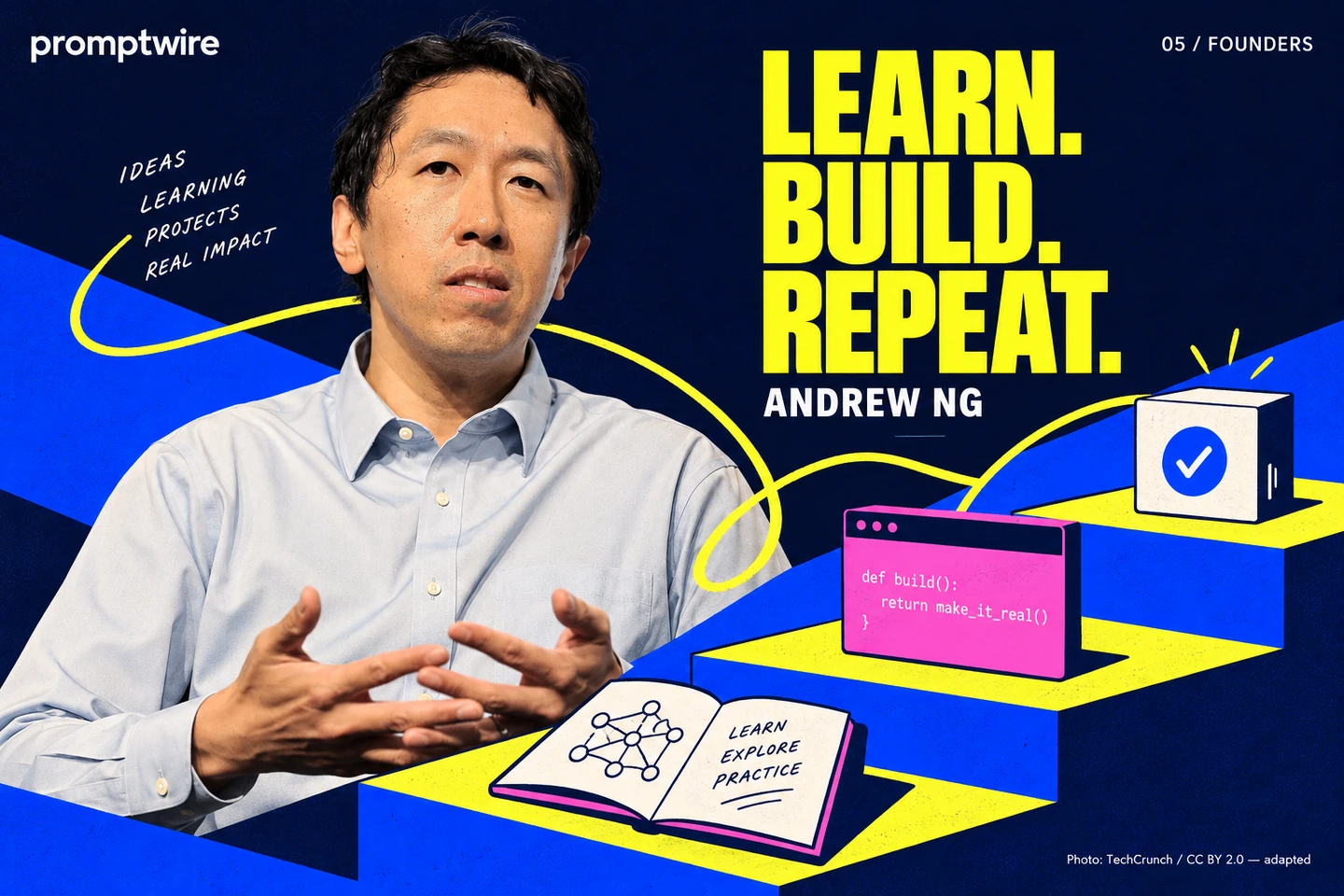
Andrew Ng founded DeepLearning.AI and co-founded Coursera. His official biography also records leadership roles at Google Brain and Baidu. His profile connects AI research, practical adoption and education, with a useful question for learners: how do you turn familiarity with a tool into the ability to solve and evaluate a real problem?
- Person
- Andrew Ng
- Company
- DeepLearning.AI
- Area of work
- AI education and practical adoption
A founder focused on learning
Andrew Ng’s official biography identifies him as the founder of DeepLearning.AI and a co-founder of Coursera. His career also includes leading Google Brain and serving as Baidu’s chief scientist. Those roles connect three parts of the AI ecosystem: research, product development and education.
Public record: DeepLearning.AI: founder biography or company record
What should AI literacy enable someone to do?
Recognising terms is useful, but operational literacy goes further. A learner should be able to frame a task, select suitable information, inspect an output and recognise when a system is unsuitable. A manager needs enough understanding to ask about failure modes and ownership, even if they do not train models. Ng's public career links research with education, making this distinction especially relevant. Our analysis is that good AI education should leave people better able to make decisions, not merely more confident using a chat interface.
Why a small project can teach more than a tool list
A well-chosen project exposes the whole loop from problem to evaluation. For example, classifying a set of fictional customer enquiries requires a definition of each category, examples of ambiguous cases and a way to count errors. The learner can then compare a simple rule-based approach with an AI approach. This reveals when the model adds value and where it creates uncertainty. It is a proposed learning exercise, not a statement that Ng recommends this exact curriculum or that we ran a course study.
How to build a sensible learning path
Begin with one recurring task in a domain you understand. Learn the concepts needed to explain its inputs, outputs and failure cases. Create a small set of examples before experimenting, then keep a record of changes and results. Add technical depth when a concrete limitation demands it: retrieval for missing knowledge, structured outputs for integration or evaluation methods for inconsistent quality. This approach connects conceptual learning with evidence. It avoids assuming that completing a course alone proves readiness to deploy an AI system for other people.
Questions about Andrew Ng
Did Andrew Ng found DeepLearning.AI?
Yes. His official biography identifies him as its founder and also lists his role as a co-founder of Coursera.
Do I need to train a model to start learning AI?
No. You can begin by framing a task, using an existing system and evaluating its outputs. Training becomes relevant when the problem and your learning goals call for it.
Follow the evidence.
This AI-assisted profile combines the linked public record with Promptwire's editorial analysis. It is not an interview or a hands-on product review. Suggested tests are proposals, not reported results. Dated roles describe the period identified in the text. Company claims are attributed to their source.
Public sources support the factual background. Analysis and illustrative exercises are identified in the text. How we assess AI · Editorial standards
Spot a factual error or an outdated detail?